“Try Again”
Let us do these activities before we read
Who inspires you to do your best?
Students, different people inspire us in different ways. Some of us are inspired by our parents, some by
our teachers, and some by great personalities. Inspiration gives us the strength to continue even when
things become difficult.
Observe the pictures given on the page.
We can see birds building nests, a spider making a web, ants working together, birds flying in groups,
and a tree full of fruits.
What do all these pictures have in common?
They all teach us that success comes through patience, hard work, and continuous effort.
The spider does not stop making its web.
The ants do not stop carrying food.
The bird does not stop building its nest.
Nature teaches us a very important lesson—never give up.
And that is exactly the message of today’s poem.
Let Us Read
Stanza 1
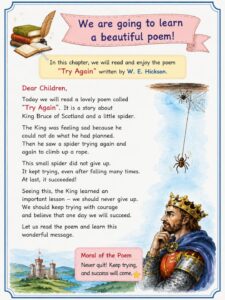
King Bruce of Scotland flung himself down
In a lonely mood to think;
‘Tis true he was monarch, and wore a crown,
But his heart was beginning to sink.
In this stanza we meet King Bruce of Scotland.
Although he was a king and wore a crown, he was not happy.The poet uses the word monarch, which simply means a king or ruler.
The line “his heart was beginning to sink” tells us that he was slowly losing hope.
Have you ever worked very hard for something and still not succeeded?
That feeling of disappointment is exactly what King Bruce was experiencing.
Stanza 2
For he had been trying to do a great deed,
To make his people glad;
He had tried and tried, but couldn’t succeed
And so he became quite sad.
Now the poet tells us why Bruce was unhappy.
He wanted to do a great deed, which means an important task or achievement, for the benefit of his people.
He wanted to make them glad, or happy.
But despite many attempts, he could not succeed.
Notice how the poet says, “tried and tried”
This shows that Bruce did not fail because he was lazy. He failed even after making many efforts.
Naturally, this made him feel sad and discouraged.
Sometimes success takes longer than we expect. That does not mean we should stop trying.
Stanza 3
He flung himself down in low despair,
As grieved as man could be;
And after a while he pondered there,
“I’ll give it all up,” said he.
In this stanza, Bruce feels completely hopeless.
The word despair means a complete loss of hope.
The word pondered means thought deeply. Bruce was sitting alone, thinking seriously about his failures.
In fact, he had become so discouraged that he decided to give up.
This is often the most dangerous moment in life—not failure itself, but the decision to stop trying.
Let’s see what happens next.
Stanza 4
Now just at that moment a spider dropped,
With its silken, filmy clue;
And the King, in the midst of his thinking, stopped
To see what the spider would do.
Just then, something interesting happened.
A spider appeared and came down hanging from a thin silk thread.
The poet describes the thread as silken and filmy, meaning soft, silky, and very thin.
Bruce stopped thinking about his own problems and began watching the spider.
Little did he know that this tiny creature was about to teach him one of the greatest lessons of his life.
Stanza 5
‘Twas a long way up to the ceiling dome,
And it hung by a rope so fine;
That how it would get to its cobweb home,
King Bruce could not divine.
The spider’s web was high up near the ceiling.
The spider was hanging from a very thin thread.
Bruce looked at it and wondered how such a tiny creature could ever reach its home.
The word divine here means “to guess or understand”
The task looked almost impossible.
Sometimes our goals also seem very difficult. But difficult does not mean impossible.
Stanza 6
It soon began to cling and crawl
Straight up with strong endeavour;
But down it came with a slippery sprawl,
As near to the ground as ever.
The spider began climbing.
It started moving upward with great determination.
The poet uses the word endeavour, which means effort.
But suddenly the spider slipped and fell.
All its hard work seemed wasted.
Have you ever prepared well for a test but still not got the marks you expected?
That is exactly how failure feels.
Stanza 7
Up, up it ran, not a second to stay,
To utter the least complaint;
Till it fell still lower, and there it lay,
A little dizzy and faint.
The amazing thing about the spider was that it did not complain.
It immediately began climbing again.
But once more it slipped and fell.
This time it fell even lower than before.
The spider looked weak and tired.
Yet it did not give up.
Successful people do not waste time complaining.
They focus on trying again.
Stanza 8
Its head grew steady—again it went,
And travelled a half-yard higher;
‘Twas a delicate thread it had to tread,
And a road where its feet would tire.
After resting for a moment, the spider recovered.
It started climbing once again.
This time it managed to go higher than before.
The thread was very delicate, meaning thin and fragile.
Even though the path was difficult, the spider continued moving forward.
Every success story includes challenges.
The important thing is to keep going.
Stanza 9
Again it fell and swung below,
But again it quickly mounted;
Till up and down, now fast, now slow,
Nine brave attempts were counted.
Once again the spider fell.
But once again it climbed.
The poet tells us that the spider made nine attempts.
Sometimes it moved fast.
Sometimes it moved slowly.
But it never stopped.
Notice that the poet calls these attempts brave.
Why brave? Because real courage means continuing even after failure.
Stanza 10
“Sure,” cried the King, “that foolish thing
Will strive no more to climb;”
Now Bruce started thinking like many people do.
He felt the spider had already failed too many times.
The word strive means to try very hard.
Bruce believed the spider would finally stop trying.
Many people quit just before success arrives.
Let’s see what the spider does next.
Stanza 11
But up the insect went once more,
Ah me! ’tis an anxious minute;
He’s only a foot from his cobweb door,
Oh say, will he lose or win it?
To Bruce’s surprise, the spider tried again.
Now it was very close to its web.
The king watched nervously.
The poet creates suspense here.
The spider is only a short distance away from success.
Students, imagine you are watching a cricket match where only one run is needed to win.
That is the kind of excitement Bruce felt.
Stanza 12
Steadily, steadily, inch by inch,
Higher and higher he got;
And a bold little run at the very last pinch
Put him into his native cot.
The spider moved slowly but steadily.
The phrase inch by inch shows that progress was slow.
But it was moving forward.
Finally, with one last brave effort, it reached its web.
The phrase native cot simply means its home.
Success often comes slowly.
The important thing is not speed but persistence.
Stanza 13
“Bravo, bravo!” the King cried out,
“All honour to those who try;
The spider up there, defied despair;
He conquered, and why shouldn’t I?”
Bruce was delighted.
He shouted, “Bravo!” which means “Well done!”
The spider had defied despair, meaning it refused to lose hope.
It had conquered, or won the battle against failure.
Suddenly Bruce realized something important.
If such a tiny creature could succeed after so many failures, then why couldn’t he?
Students, sometimes inspiration comes from the most unexpected places.
Stanza 14
And Bruce of Scotland braced his mind,
And gossips tell the tale,
That he tried once more as he tried before,
And that time did not fail.
Inspired by the spider, Bruce gathered courage again.
The phrase braced his mind means he strengthened his determination.
He decided to make one more attempt.
And this time, he succeeded.
Students, that is why this poem is called “Try Again.”
The spider never gave up.
Bruce never gave up.
And because they kept trying, they finally achieved success.
Conclusion
Students, the message of this poem is simple but powerful.
Failures are not the end of the journey.
Every failure teaches us something.
If we keep trying with patience, courage, and determination, success will eventually come.
Whenever you face difficulties in studies, sports, or life, remember the spider in this poem.
Don’t quit.
Don’t lose hope.
Just try again.
Thank you, students. See you in the next class!
Let us Discuss
I. Complete the summary of the poem by filling in the blanks with suitable words from the text
given in the box below. Share your answers with the teacher. An example has been given.
tried mounted despair attempts great
conquered low strive
The poem, written in a narrative style, tells the story of King Bruce of Scotland, who was feeling 1.
________ after failing multiple times to achieve something 2. ________ for his people. In a moment of
3. ________, he observed a spider trying to reach its web high above. The spider 4. ________ every time
it fell after getting close to its goal. It made nine 5. ________ and finally succeeded. The king said that
the spider had 6. ________, and so would he. Inspired by the spider’s determination, King Bruce decided
to 7. ________. When he 8. ________ this time, he ultimately succeeded.
Answers –
1. low
2. great
3. despair
4. tried
5. attempts
6. conquered
7. strive
8. mounted
II. Complete the following sentences
1. We can say that the poet uses the narrative style because
Answer – he tells the story of King Bruce and the spider in a sequence of events.
2. The central idea of the poem is
Answer – we should never give up and should keep trying until we succeed.
III. Pick three examples from the poem
1. Lines that describe the spider’s efforts
“It soon began to cling and crawl”
“Again it fell and swung below, But again it quickly mounted.”
“Steadily, steadily, inch by inch, Higher and higher he got.”
Example of alliteration
cling and crawl (c sound)
“It soon began to cling and craw”
half-yard higher (h sound)
“And travelled a half-yard higher”
Higher and higher (h sound repeated)
“Higher and higher he got”
IV. Why does the poet repeat the following words or phrases in the poem?
1. tried and tried
Answer: The poet repeats “tried and tried” to emphasize the king’s repeated efforts and
determination despite failing many times.
2. steadily, steadily
Answer: The repetition of “steadily, steadily” shows that the spider climbed slowly, patiently,
and without giving up.
3. up, up
Answer: The poet repeats “up, up” to stress the spider’s continuous upward movement and its
determination to reach its web.
Fill in the blanks by choosing the correct answer from within the brackets.
1. The rhyme scheme of the poem is ____________. (AABB/ABBA/ABAB)
2. ‘Bravo’ is an example of ____________. (conjunction/interjection/adjective)
3. The poet uses ‘twas and ‘tis for the sake of ____________. (rhythm/rhyme/contraction)
Answer:
1. The rhyme scheme of the poem is AABB. (AABB / ABBA/ ABAB)
2. ‘Bravo’ is an example of interjection. (conjunction/interjection/ adjective)
3. The poet uses ‘twas and ‘tis for the sake of contraction, (rhythm / rhyme / contraction)
VI. The spider’s climbing is compared to King Bruce’s own struggles. Just as the spider
repeatedly attempts to reach its web, Bruce is trying to achieve a great deed for his people. This
poetic device is called metaphor. It strengthens the poem’s message about perseverance—keep
trying till we succeed.
A metaphor is a figure of speech that involves an implied comparison between two unlike things
without using ‘like’, ‘as’, or ‘as…as’. It suggests that one thing is another, highlighting similarities
between them to add deeper meaning or understanding.
Question 1.
Read the following sentences and identify metaphors and similes.
Write M for metaphor and S for simile.
(i) He ran as fast as a cheetah. ___
(ii) The world is a stage. ___
(iii) The night was as dark as coal. ____
(iv) He sang like an angel. ____
(v) Her voice was music to his ears. ____
(vi) The classroom was a zoo. ____
(vii) The baby slept like a log. ____
(viii) Her smile was as bright as the sun. ____
(ix) The lake was a mirror, reflecting the sky. ____
(i) He ran as fast as a cheetah. S
(ii) The world is a stage. M
(iii) The night was as dark as coal. S
(iv) He sang like an angel. S
(v) Her voice was music to his ears. M
(vi) The classroom was a zoo. M
(vii) The baby slept like a log. S
(viii) Her smile was as bright as the sun. S
(ix) The lake was a mirror, reflecting the sky. M
Question 2.
Read the following sentences and transform the similes to metaphors and metaphors to similes. Two
examples have been given.
(i) Knowledge spreads like the branches of a mighty tree.
Knowledge is a spreading branch of a mighty tree.
(ii) His courage was a beacon, guiding us through the storm.
His courage was as bright as a beacon guiding us through the storm.
His courage was like a beacon guiding us through the storm.
(iii) The book was a treasure chest, filed with endless adventures.
Answer: The book was like a treasure chest, filled with endless adventures.
(iv) Her laughter was a melody that brightened the darkest days.
Answer: Her laughter was like a melody that brightened the darkest days.
(v) The mountain stood as a guard, watching over the valley below.
Answer: The mountain was a guard, watching over the valley below.
(vi) The night was like a velvet cloak, wrapping the world in mystery.
Answer: The night was a velvet cloak, wrapping the world in mystery.
(vii) Her thoughts were like butterflies in a summer meadow.
Answer: Her thoughts were butterflies fluttering in a summer meadow.
Question 1
Read the extract given below and answer the questions that follow.
He flung himself down in low despair,
As grieved as man could be;
And after a while he pondered there,
“I’ll give it all up,” said he.
Now just at that moment a spider dropped,
With its silken, filmy clue; »
(i) Select the phrase which shows the physical expression of the King’s emotional state.
Answer:
“He flung himself down in low despair.
(ii) Why does the poet use the word “low” before “despair”?
Answer:
The poet uses the word “low” to show that King Bruce was deeply sad and had almost lost all hope.
(iii) Choose the correct option to complete the sentence.
In the line, “And after a while he pondered there,” the word “pondered” means ________.
A. paused
B. thought
C. noticed
D. rested
Answer: B. thought
—
(iv) Choose the correct option from the words given in the brackets.
The phrase ‘silken, filmy clue’ creates an image of something that is ________.
(long and light / very delicate and soft)
Answer: Very delicate and soft
Question 2
Read the extract given below and answer the questions that follow.
When it toils so hard to reach and cling,
And tumbles every time!
But up the insect went once more,
Ah me! ’tis an anxious minute;
He’s only a foot from his cobweb door,
Oh say, will he lose or win it? »
(i) Choose the correct option to complete the analogy.
toil : hard :: ________ : ________
A. roll : tumble
B. tumble : circle
C. compress : roll
D. jump : tumble
Answer: A. roll : tumble
(ii) List any two characteristics of the spider highlighted in the line, “But up the insect went once more.”
Answer: 1. Perseverance 2. Determination
(iii) Choose the correct option to complete the sentence.
The expression “Ah me!” in the extract indicates a sense of ________.
A. happiness
B. stress
C. relief
D. loneliness
Answer: B. stress
(iv) Complete the sentence with an appropriate reason.
Readers are able to relate to this extract because __________________________.
Answer: Readers are able to relate to this extract because it teaches us never to give up, even after
repeated failures.
II. Answer the following questions.
1. How does the first stanza help in setting the mood of the poem?
Answer: The first stanza sets a sad and hopeless mood. It shows that King Bruce is disappointed after
failing many times.
2. Describe how King Bruce’s attitude changes from the beginning towards the end of the poem.
Answer: At the beginning, King Bruce is sad and ready to give up. By the end, he becomes confident,
hopeful, and determined to try again.
3. The poet describes every action of the spider in great detail. What does this tell us about his attitude
towards the spider?
Answer: It shows that the poet admires the spider's patience, courage, and determination. He wants
readers to learn from its example.
4. How does the spider inspire us to overcome despair and not give up?
Answer: The spider keeps trying even after falling many times. It teaches us to face difficulties with
courage and never give up.
5. The poem teaches us that failures are stepping stones to success. Explain.
Answer: The spider succeeds only after many failed attempts. King Bruce also succeeds when he tries
again. This shows that failures help us learn and lead us to success.
6. The spider’s journey tells us that anyone can be a source of inspiration in our lives. Elaborate.
Answer: Even a small spider inspired King Bruce to try again. This teaches us that we can learn valuable
lessons from anyone or anything around us.
Let us learn
Write the opposite of the following words taken from the poem.
1. up x down
2. fast x slow
3. glad x sad
4. win x lose
5. succeed x fail
III. Choose the correct meaning of the underlined words and frame sentences of your own.
1. Endeavour
Meaning: An attempt to do something new or difficult.
Sentence: Rohan’s endeavour to learn a new language was successful.
2. Toil
Meaning: Work very hard and/or for a long time.
Sentence: Farmers toil in the fields all day to grow crops.
3. Strive
Meaning: To try very hard to achieve something.
Sentence: Students must strive to achieve their dreams through hard work.
4. Braced
Meaning: Prepared themselves for something difficult.
Sentence: The team braced themselves for a tough competition.
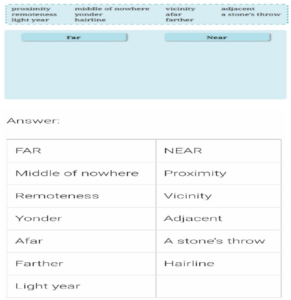
III. The poem uses words that show distance.
Examples from the poem:
a long way up, inch by inch, higher and higher, half-yard higher
Classify the words or phrases given in the box into Far and Near and write in the space provided. You
may take the help of a dictionary.